Soil
Soil is where most people trip up first, because “organic” potting soil is usually where the animal products are hiding. Bone meal, blood meal, feather meal, and manure are standard amendments in bagged “organic” mixes, and worm castings turn up in just about everything sold as premium. Same rule as the nutrients page: read the actual bag, don’t trust the branding, and keep in mind that vegan and organic are two different questions.
Here’s what I’ve used and checked myself.
Before diving in — both of these are more findable than you’d think. ProMix is a hydro store staple, usually right there on the shelf. In legal states, regular garden centers are starting to stock it too, sometimes tucked behind the begonias or in the back with the potting supplies. Coast of Maine has been showing up in regular nurseries and garden shops more and more. Worth asking at your local spots before ordering online.
That said, be careful in hydro stores specifically. They stock a lot of “natural” and “organic” products that have animal inputs hiding in the label — same problem as everywhere else. The staff can be helpful but don’t take their word for it on vegan status. Read every label yourself, same as always.
ProMix BX and HP
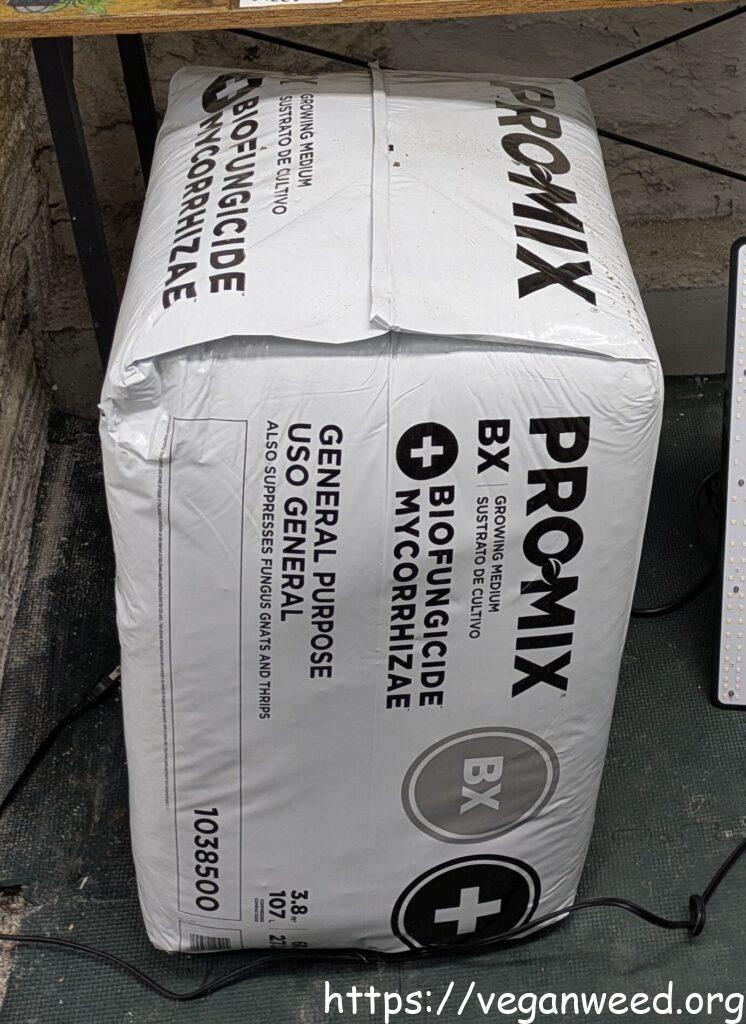
This is my go-to. ProMix is a peat and perlite base with a biofungicide (Bacillus subtilis) and a mycorrhizal inoculant mixed in. No animal inputs. It’s not really “soil” in the living-soil sense, it’s an inert soilless medium, and it’s about the closest thing to growing in coco. You feed the plant directly and the medium mostly just holds roots, water, and air. BX is the standard version. HP is the high-porosity one, more air and faster drainage, which is what I’ve been reaching for in fabric pots. Both are clean.
Couple things nobody tells you up front. First, you have to wet it before you use it. Straight out of the bag it’s bone dry and peat is stubborn about taking water. What I do is dump some into a 5-gallon bucket, add water, mix it up by hand, and keep going until it’s evenly moist all the way through. You’re aiming for a consistency where you can squeeze a handful and get little to no water running out. If it turns into soup, just add more dry ProMix back in until it feels right. Then fill your pots with that. Skipping this step is how you end up with dry pockets the water just runs around later.
Second, it comes with a little bit of starter nutrient charge built in, but only enough for the first couple weeks. After that it’s a blank slate and the plants are relying entirely on you. So plan to start feeding around week two, don’t wait for the plant to look hungry.
Because it drains and behaves like coco, you water it like coco too. Water until you get a little runoff, maybe 15-20% of what you put in coming out the bottom, which keeps salts from stacking up in the medium. You don’t need runoff every single watering, but regularly. Get some risers or pot feet so the pots aren’t sitting in the runoff after (learned that one the wet way).
The one thing to genuinely avoid is letting it dry all the way out. Peat goes hydrophobic when it gets too dry, meaning it stops accepting water and starts repelling it, and then your waterings just channel down the sides and out the bottom without ever wetting the root zone (this is well documented in greenhouse production — Iowa State horticulture covers the double-watering fix for exactly this). Let it get to a nice dryback, then water. Don’t let it go bone dry between waterings.
And one quirk if you run soil moisture sensors: peat and perlite read funny on the cheap capacitance probes. Perlite is full of air and doesn’t carry the same signal as mineral soil, so “fully saturated” tops out around the mid-40s percent on the meter instead of up near 100. That’s not the probe dying on you, it’s just the medium. Your working range is your own wet-to-dry, not the 0-100 on the chart. Water also redistributes away from the probe overnight, so a next-morning reading isn’t the whole pot, just that one spot.
Coast of Maine Acadia Blend
coastofmaine.com/products/acadia-blend-potting-soil
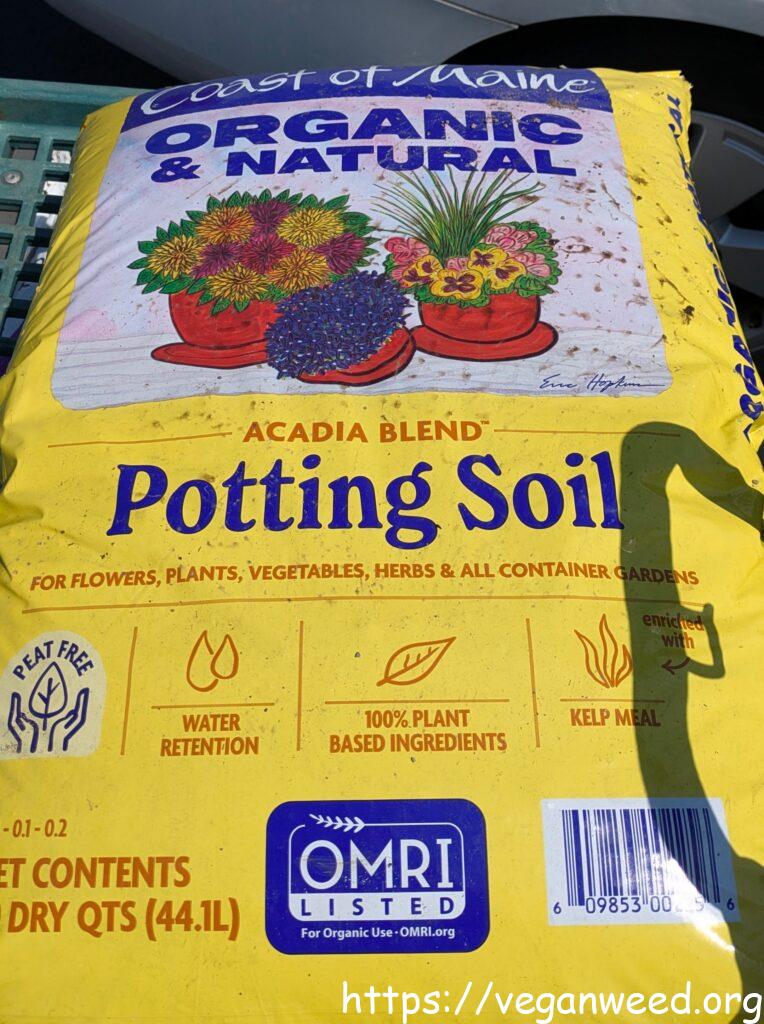
If you’d rather have something closer to a living medium than a blank slate, this is the best bagged option I’ve come across. It’s 100% plant-based and peat-free — aged bark, coconut coir, compost, and wood biochar, amended with alfalfa meal and kelp. The NPK is a gentle 0.4-0.1-0.2, so it’s not a hot pre-charged soil, it’s a mild living base you build on from there.
The biochar is the part that got my attention. You rarely find it already mixed into a bagged soil, and it earns its place — high cation exchange capacity, good home for microbes, and it hangs onto nutrients instead of letting them wash straight through (the CEC and nutrient-retention effects are well studied — see this review in Agronomy for Sustainable Development). Usually you’d have to add biochar yourself.
For cannabis in pots, the only real gap is water retention — it drains quicker than a peat-heavy mix. Cut it 60/40 with perlite and it’s a solid veganic container medium. The alfalfa and kelp are already in there, so you can top-dress a little as the plant asks for more and otherwise leave it be. It’s honestly easier than chasing down every component separately for a DIY build.
A word on trusting brands
Coast of Maine is a good lesson in why you check the product and not the brand. Acadia Blend is vegan and says so right on the bag. But the same company makes Bar Harbor Blend, which has lobster in it, and Penobscot Blend, which has composted manure and oyster shell. Three soils, one shelf, one brand, and only one of them is clean. A vegan product doesn’t make a vegan brand. Flip every bag over.
A quick note on mycorrhizae
Plenty of bagged soils and standalone inoculants brag about mycorrhizae, and it’s worth knowing what you’re actually getting. The species that matters for cannabis is an endomycorrhizal fungus, usually Rhizophagus intraradices (you’ll see the older name Glomus intraradices on some labels). The thing is, these fungi need direct contact with living root tissue to colonize, and they get shut right down when there’s plenty of phosphorus around, since the whole partnership exists to help the plant reach phosphorus it otherwise can’t. So an inoculant does its work early, at transplant, on the root ball, in a lower-P environment. Sprinkled on top of an established, well-fed plant it mostly just sits there. Nice to have in the mix from the start, not a magic powder you dump on later. (More on this in the Mykos writeup once it’s up.)
On living soil and no-till
There’s a whole world of veganic living soil and no-till growing out past bagged mediums. The idea is you build a soil that runs as its own little biological system, feed the microbes instead of the plant, and eventually just add water. Done right you end up with a bed you barely have to touch that actually gets better over the years. It’s a beautiful idea, and it lines up with growing without animal inputs about as deeply as anything can.
It’s real, it works, and the vegan approach swaps plant and mineral inputs — alfalfa, kelp, neem, rock dusts, compost, malted barley — in for the fish, bone, blood, and crab meals that fill most of the standard recipes. Once I’ve actually run one and have something honest to say about it, it’ll get its own page. For now, just take this as a nod in that direction, not a how-to.