Grow Methods
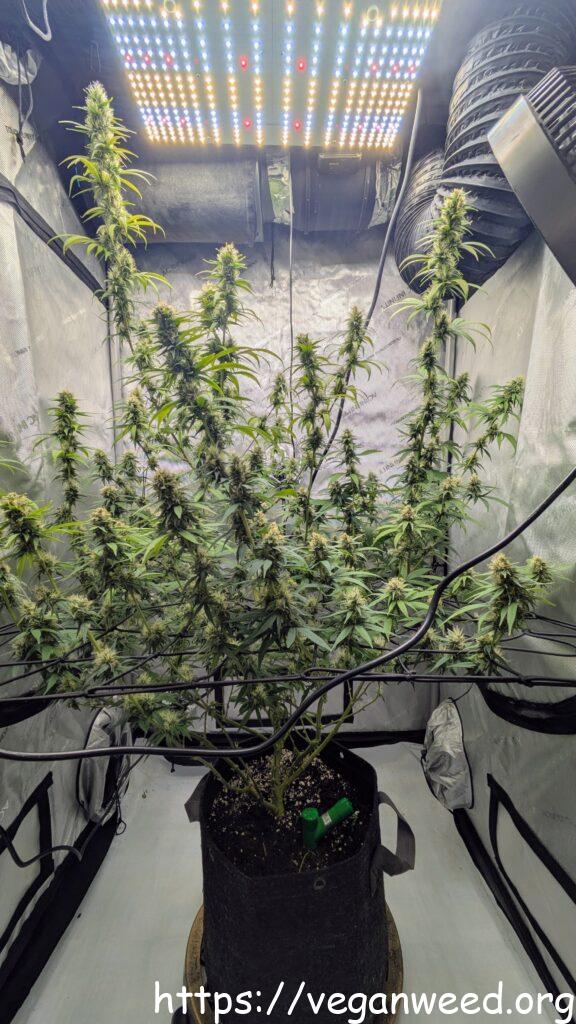
This page covers my vegan cannabis growing setup — the medium, how I water and feed, the beneficial things I add to the root zone, and the thinking behind all of it.
The vegan part ties in more directly here than you might think — a lot of this approach comes down to working with biology rather than industrial chemistry, and that’s easier to do when you’re already reading every label.
The growing setup
I grow in a soilless medium indoors under LED. Soilless means the growing medium itself starts out with almost no nutritional value — it’s there to support roots, hold water, and allow airflow, not to feed the plant. All the nutrition comes from what I put in the water. That might sound like more work but it’s actually cleaner and more precise. You decide exactly what goes in, which for a vegan grow means there are no surprises hiding in the bag.
The medium is ProMix HP, a blend of peat and perlite. Peat is a lightweight, slightly acidic organic material that holds moisture and gives roots something to grip. Perlite is expanded volcanic glass — full of air pockets, doesn’t hold water, opens up the mix and keeps the root zone from getting waterlogged. Together they drain well, dry back predictably, and let roots breathe. Because it’s basically inert after the first week or two (there’s a small starter charge that fades quickly), it behaves almost exactly like growing in coco coir. The difference is ProMix comes with two living things already in the bag: Bacillus subtilis, a beneficial bacteria that acts as a biofungicide (it colonizes the root zone and suppresses soil-borne pathogens through competition and antibiosis — reviewed here), and a mycorrhizal inoculant. From the moment you plant, there’s biology already moving in the root zone. More on both of those below.
pH
pH is a measure of acidity or alkalinity on a scale from 0 to 14, with 7 being neutral. In the root zone, pH determines whether nutrients are actually available for the plant to absorb or chemically locked up in forms the roots can’t use. Every element has a pH range where it’s accessible. Iron becomes available around 5.5–6.5. Phosphorus peaks around 6–7. Calcium and magnesium stay available across a wider range but drop off below 5.5. The overlap zone where everything stays accessible at once is roughly 6.0–6.5 in a peat-based medium (the University of Maryland Extension has a clear breakdown of this per nutrient).
I pH every watering to 6.0 going in. ProMix runs slightly acidic on its own, so 6.0 into the medium keeps things in the right range without fighting the material. If runoff pH is drifting, the root zone is drifting with it, and eventually certain nutrients lock out — physically present but chemically unreachable. Keeping pH steady is the simplest way to prevent most deficiencies before they start.
How I water and feed
I alternate between feed waterings and plain water waterings. A feed watering has the full nutrient stack. The next watering is plain water with just CaMg+ and Mr. Fulvic. Then back to nutrients. Feed, rinse, feed, rinse.
The reason for the plain water days is salt management. EC, or electrical conductivity, is a measure of dissolved solids in water — basically how “salty” your solution is. Every time you feed, some of what the plant doesn’t immediately absorb stays behind in the medium. Over many waterings, EC builds up in the root zone. At high enough levels it starts to work against water and nutrient uptake, because osmosis starts pulling in the wrong direction — when the solution outside the roots gets saltier than the water inside them, water gets drawn back out instead of in. The plain water days flush some of that accumulated salt out with the runoff, keeping the root zone in a range where the plant can actually eat and drink comfortably.
I aim for around 15–20% runoff on feed days — enough to flush without wasting everything. Pot risers or pot feet matter here so plants aren’t sitting in their own runoff afterward.
Mycorrhizal fungi
Mycorrhizal fungi are one of the oldest relationships in plant biology. Around 450 million years ago, when plants were first colonizing land, they formed partnerships with soil fungi that persist to this day. The fungus threads microscopic filaments called hyphae out through the growing medium, far beyond where roots can physically reach, pulling in water and nutrients — especially phosphorus, which is hard for roots to find on their own. In exchange, the plant feeds the fungus sugars it makes through photosynthesis. Both sides get something they couldn’t get alone.
Published research on Rhizophagus species in cannabis seedlings has shown significant positive effects on root development, dry biomass, and nutrient uptake, with higher colonization rates correlating to better growth outcomes across the board. (Giannakis et al., Plants 2021). The species in Mykos is Rhizophagus intraradices — you’ll also see the older name Glomus intraradices on products and in older papers, same fungus, just reclassified in 2012.
The main thing to know about application is timing. These fungi need two things to establish: direct contact with living root tissue, and a relatively low-phosphorus environment. The whole reason the plant makes this deal is to reach phosphorus it can’t find on its own. When phosphorus is already abundant in the root zone, the plant doesn’t send the signal, and the fungus doesn’t colonize. So Mykos goes in at transplant, directly on the root ball, before the full feeding schedule starts. That’s when it can actually do something. Adding it later to an actively-fed plant is mostly wasted.
Down to Earth Fertilizer put together a short video that walks through the whole mycorrhizae concept well:
Humic and fulvic acids
Humic and fulvic acids form when organic matter — mostly plant material — decomposes over very long periods of time. Millions of years in some deposits. They’re complex organic molecules found naturally in healthy soils, and they do several things that matter in a growing context.
The most useful one is chelation. Certain nutrients, especially micronutrients like iron, copper, and manganese, have a hard time crossing into plant root cells on their own. Fulvic acid molecules wrap around them and carry them across the cell membrane — the term chelation comes from the Greek word for claw. Once the nutrient is inside, the fulvic molecule releases it and goes back for another pass. It’s a nutrient shuttle. In a soilless medium without the rich organic chemistry of a living soil doing this work naturally, a little fulvic acid every watering makes the nutrients you’re already providing more available to the plant.
Humic acids are larger molecules in the same family. They work more on soil structure and microbial environment than on nutrient transport directly, so they’re less central in a soilless setup, but they contribute to the root zone environment. Mr. Fulvic is mined from a 30-million-year-old humic shale deposit and water-extracted, which keeps more of the fulvic fraction intact than chemical extraction methods. I run it at 1ml/gal every watering, both feed and plain-water days.
Another good explainer from Down to Earth on the humic acid side of things:
How the vegan side connects
Honestly, reading every label for animal products taught me more about nutrients than the previous year of growing had. You can’t substitute something you don’t understand, so you end up learning what each ingredient is actually doing and why. That’s how I got into chelation, soil biology, and the mechanisms underneath the products.
There’s a practical side too. When you store mixed organic nutrients, animal-derived inputs — fish emulsion, protein hydrolysates — break down fast. They go anaerobic, they smell bad, and they invite root pathogens. Plant-derived inputs still need management in a reservoir (keep it aerated, don’t let it sit more than a couple days, keep the lines clean), but they don’t rot the same way. The clean choice and the easier choice ended up being the same one.
The through-line
Everything here follows the same logic: set up conditions that support living systems, then get out of the way. The mycorrhizal fungi reach where roots can’t. The fulvic acid ferries nutrients home. The bacteria in the ProMix protects the root zone. The alternating watering keeps the whole environment balanced. My job is pH, clean water, and not letting salts stack up. The rest is biology doing what it’s been doing for hundreds of millions of years.
For the specific nutrients I use and why, those are on the Nutrients page. Soil and media choices are covered on the Soil page.
Going vegan with inputs is what pushed me in this direction. When you’re reading every label anyway, you start asking what each thing actually does, and that question tends to lead somewhere interesting.